FousBrowser agents or methods
Browser agents or typed methods
A browser agent decides what to do on the page as it goes. A Fous method is built once for one job and then runs the steps it learned. Agents are the better fit for varied tasks, and methods for the same job repeated with different inputs.
Updated
How they compare
| AI browser agents | Fous methods | |
|---|---|---|
| Getting started | Give it a task and a site. There is no build step. | A build first, usually about a minute, tested on real inputs. |
| During a run | An AI model reads the page and picks the next step in a real browser. Some products can replay cached steps instead. | The steps learned at build time. No AI model takes part in a method run. |
| What comes back | Depends on the task and the product. Several can extract to a schema you define. | A typed input and output on every method, so each run has the same fields. New fields arrive as a version you choose. |
| When a site changes | The agent can adapt during the run, and cached steps are regenerated. | Fous repairs the method in place and keeps its inputs and outputs, at no cost. |
| Range of tasks | Broad: it can attempt whatever you describe. | Each method does the one job it was built for, the same way every time. |
| What you pay for | Varies by product, typically browser time, model use or task steps. | Each completed run uses 1 credit, and failed runs are free. |
When a browser agent is the better choice
- The task is different each time, or you don’t know the site in advance.
- You need it once or twice, so a build step isn’t worth it.
- A person will review the result anyway.
When a typed method is the better choice
- The same job repeats with different inputs, such as an order number or a company name.
- Other software reads the result, so its fields have to be the same on every run.
- The job sits behind a login and has to keep running after sessions expire. See Connections.
- The job runs on a schedule with nobody watching. See Workflows.
What these products say about themselves
Browser agents are moving quickly, and several now reuse earlier work. As of November 2026:
- Skyvern opens a real browser and reads each page to do the work you describe. Its code caching can replay a recorded run without model calls, and falls back to the agent when the cached code fails.
- Stagehand can cache actions so that repeat runs make no model calls.
- Browser Use offers hosted agents that drive a cloud browser, and direct connections for your own code.
Caching makes repeat runs of an agent cheaper and more consistent, and it brings them closer to a method. The difference that remains is what you start from: a task an agent carries out, or a tested API with a contract and a repair process around it.
Using both together
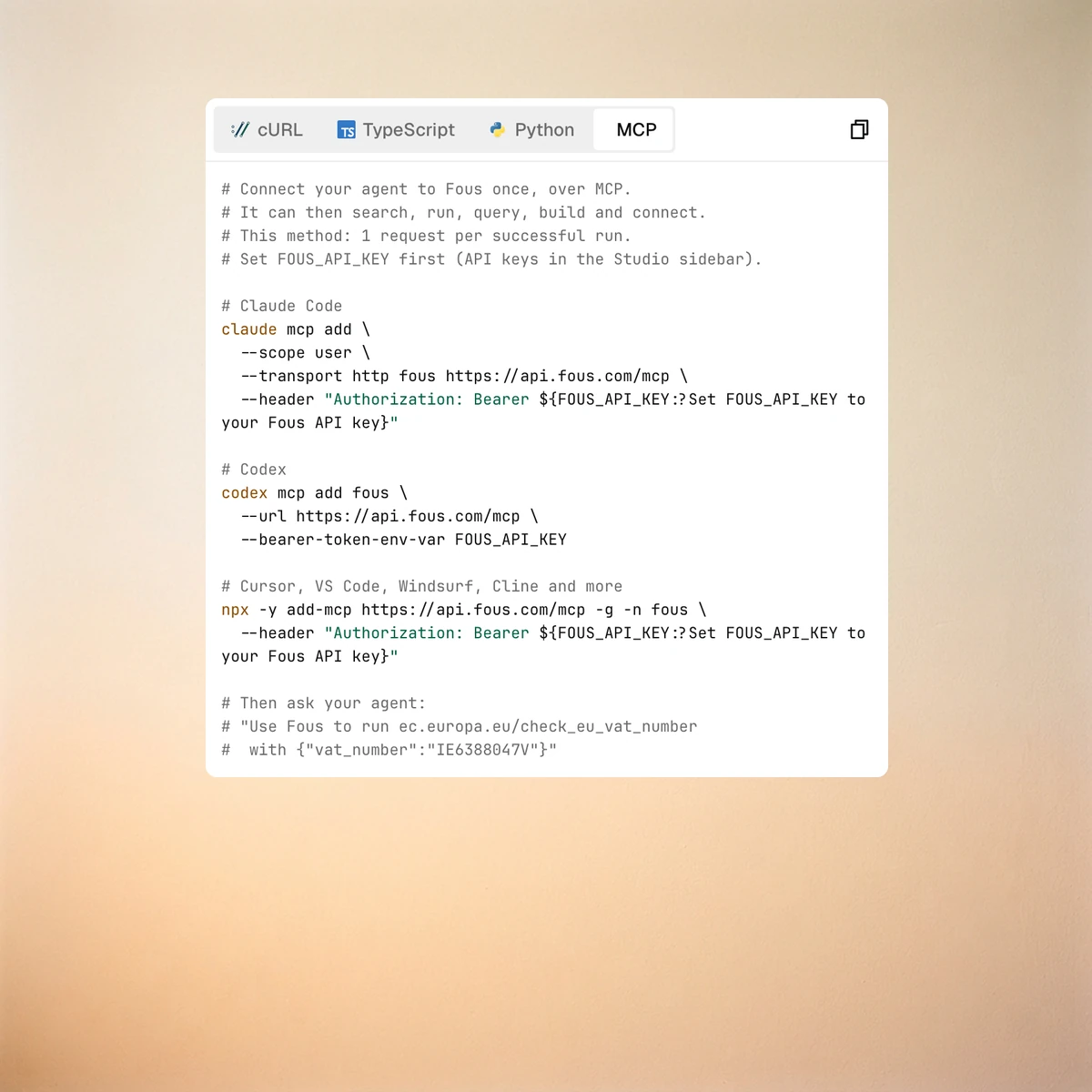
The two also work as layers. An agent such as Claude Code, Codex or Cursor can decide what needs doing and call your methods over MCP for the website part, so it gets typed results without driving a browser itself. Methods that change something go through a separate tool that its host can ask a person to approve.
Frequently asked questions
No. AI builds and repairs a method, but a run follows the steps learned at build time, with no AI model choosing what to do.
Yes. Any agent that speaks MCP can find, build and run your methods, and handle anything else itself.
A build that doesn’t succeed costs nothing.
A completed run uses 1 credit and failed runs are free. Free includes 100 credits a month, and paid plans start at $29 a month for 1,000 credits.
Build a method for a job you repeat
Describe it in Studio with 100 credits a month and no credit card, or book a demo and bring the portals your team works in.